
Engaging in the future
Hi everyone, it’s been a while since my previous newsletter. I’ve been quite busy lately (more on that later). So it feels good to take some time to write and send this newsletter today. Feel free to share this email with a friend, it really helps 💌 Sign up here.
Engaging in the future
This week, I found myself on the staircase of a building at Place Vendôme in Paris, surrounded by reporters trying to ask questions to Jensen Huang.
The Nvidia CEO was in town as part of a European tour. Earlier that evening, Nvidia had invited founders, VCs and reporters to a special event where Huang made a handful of announcements.
First, Nvidia has invested nearly $8 billion in European companies in the past year, and the company plans to invest another $2 billion in the coming weeks. Second, Nvidia is investing in four French startups: Doctolib, Entalpic, Genesis AI, Pigment.
Unfortunately, Nvidia didn’t share additional details. From what I’ve heard, the investments in the four French startups are small, strategic stakes.
I suspect Nvidia's largest European investments will continue to go to neoclouds, such as Nebius and Nscale (already $3 billion invested in these two companies alone), rather than software companies like Doctolib and Pigment. As a reminder, neoclouds buy enormous quantities of Nvidia GPUs, and Nvidia loves to invest in its own customers.
Let's go back to the event itself. Inside the building at Place Vendôme, you could feel the excitement in the room as he took the stage, following a short video highlighting the positive impact of AI.
France’s economy minister Roland Lescure also said a few words, but he wasn’t the star of the show. (A young entrepreneur even asked me who this person was.)
One thing stood out to me during his speech. Huang talked a lot about AI safety. He downplayed the risks of AI getting out of control and advocated for isolated testing environments (what developers usually call sandboxes), real-time monitoring and human-designed boundaries.
“Safety is not alignment. Safety is technological engineering,” Huang said.
It sounded like a direct challenge to Anthropic’s approach to alignment research.
Luckily, I got a chance to ask him about it. After the presentation, Nvidia put together a good old media scrum with Huang on the staircase in front of the building.
This is what a media scrum looks like from a reporter’s perspective:
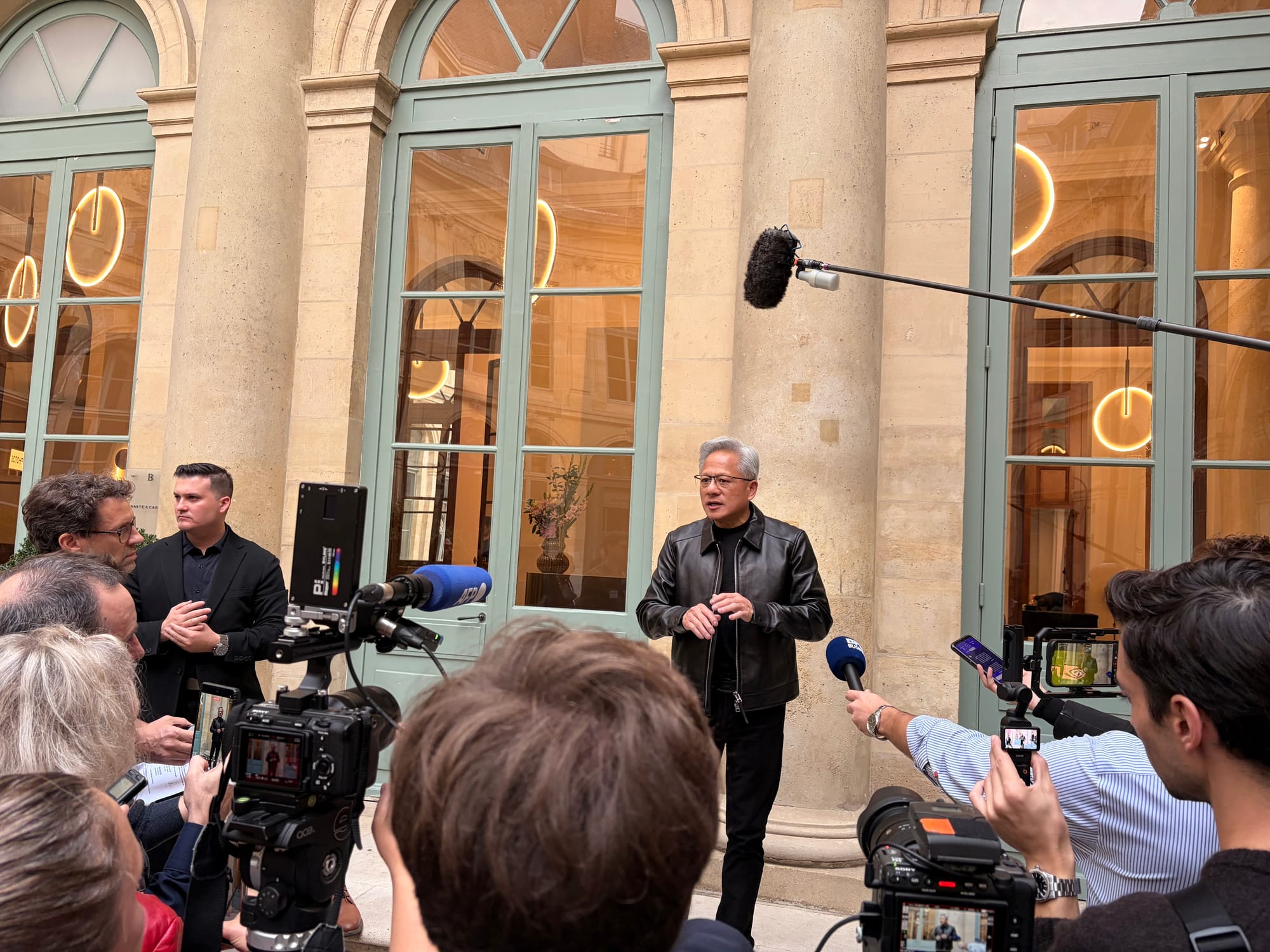
As the name suggests, it can be quite chaotic to ask a question as you have to understand when Huang is about to end his answer so that you can immediately interject and ask your question.
And the good news is that, yes, for you dear readers, I managed to ask a grand total of one question to Jensen Huang.
Here’s what I asked: “You said safety is not alignment. There are a lot of researchers working on alignment right now. Can you elaborate a bit?”
And here’s Huang’s answer in full:
Alignment will never be done. We will always be constantly aligning, as you know for everybody here.
When you tell an AI the objective, what do you want it to do? That's the goal. Alignment is how do you do it. And there are many, many different ways to achieve the goal. For example, I would like you to be have success in life. How many ways can you achieve them? It depends on your values, it depends on your culture, it depends on what's important to you.
The methods by which you achieve it are infinite. So the alignment of an AI will never be done. We need to make sure that AI can be developed and deployed safely and securely. Despite alignment, along the way it has to be secure and safe all the time. Meanwhile, alignment will get better and better.
Huang is drawing a distinction between AI alignment and AI safety. In his view, alignment is primarily a question of content moderation. For instance, how should a chatbot respond when a teenager asks whether they should harm themselves?
Safety, on the other hand, is a more fundamental engineering question, according to him. For instance, should new AI models have access to the internet while they’re being tested?
It's an interesting distinction because it reframes AI safety as a more manageable engineering challenge, rather than an open-ended research problem. Of course, alignment research and safety engineering aren't mutually exclusive. But Huang's choice of words reveals where he wants to put the emphasis.
This wasn’t the only time Huang tried to reshape the AI debate by reframing its terminology. Huang no longer says data centers. He now talks about AI factories.
“These factories will produce intelligence, which is the reason why I stopped using the word data center […] and introduced the idea of data factories,” Huang said. “Now, as you know, almost nobody likes data centers, but everybody loves factories, because factories produce valuable things, and every country could now become manufacturing countries.”
What I find particularly interesting is how much effort Nvidia is putting into shaping public perceptions of AI. For a company that primarily sells the infrastructure powering the AI boom, Nvidia is spending a remarkable amount of time explaining why AI is a force for good.
On that note, the final question during the media scrum was particularly interesting. If I remember correctly, it came from Alexandre Piquard of Le Monde. He asked about the AI backlash and whether Huang was painting an overly optimistic picture, especially as people worry about losing their jobs.
“There is no question that this technology has great potential to do good, but we have to advance it safely and responsibly. It is the responsibility of the leaders that are creating creating it to do it safely,” Huang said.
“But you want to encourage people to engage in that future,” he added.
And that’s precisely what makes the conversation around AI so fascinating. Innovation doesn’t necessarily mean progress, but historically, technological breakthroughs have largely been seen as steps forward.
With AI, that assumption is being challenged for the first time. And I still wonder whether those changes will ultimately be seen as progress.
Have a good day ☀️
Romain