
When governments pick models
Hi everyone, I hope you’ve had a nice week so far. I’d like to thank Box once again for supporting Hypertext as its very first sponsor. Feel free to share this email with a friend, it really helps 💌 Sign up here.
OpenAI’s political counteroffensive
OpenAI can only succeed if AI succeeds as a category.
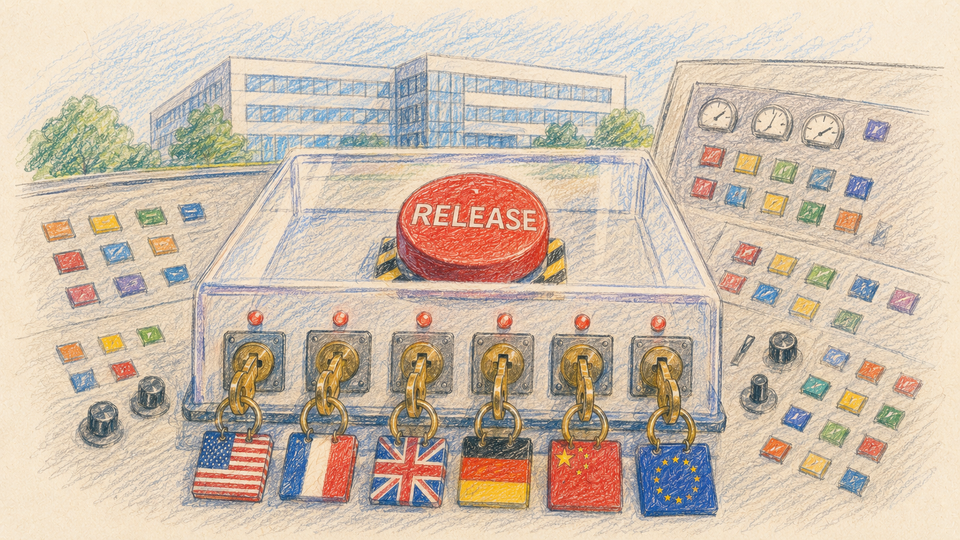
But the recent launch of the GPT-5.6 series has been worrying for the company for several reasons. Instead of making it available to everyone on June 24, the company had to cancel its plans and release it to “a small group of trusted partners” as a limited preview, at the US government’s request.
OpenAI had to announce its newest models because the cat was out of the bag. Everybody working in AI knew that the models were ready to be released. So it was better to blame the US government than pretend that GPT-5.6 didn’t exist. And they didn’t mince words.
“We don’t believe this kind of government access process should become the long-term default. It keeps the best tools from users, developers, enterprises, cyber defenders, and global partners who need them,” they wrote.
So that was step one. The two other steps they took were even more interesting. Step two, OpenAI proposed handing a 5% stake to the US government, as reported by the Financial Times. The logic is simple: if the Trump administration wants to exercise control on AI model releases, let’s take it at their word. This would tie OpenAI’s destiny with the US government.
It’s also a poison pill for OpenAI’s competitors as the company is suggesting the US government should get 5% of every AI lab based in the US. Given the on-again, off-again relationship between Anthropic and the Trump administration, they certainly don’t want to give them a seat at the table.
And finally, it’s good for optics. The AI backlash is real, especially in the US. If the US government takes a stake in AI labs, the public interest becomes more closely aligned with that of large AI companies (assuming you believe the Trump administration acts in the public interest, but that’s another story…).
Step three is the international angle. OpenAI wants to be a global leader. And that can’t happen if the Trump administration restricts exports on AI models. That’s why Sam Altman published an opinion piece in the Financial Times called “This is how we can make AI safe for everyone.”
Here’s an alternative title: “We don’t want the US government to interfere with our model releases ever again”.
Altman proposes “a US-led international forum that establishes accepted standards.” Government representatives and independent technical experts would define which models are safe to release and which should remain restricted. It clearly draws inspiration from the International Atomic Energy Agency (IAEA).
Other than the fact that I don’t see why it should be US-led, this is a genuinely smart idea.
Things have become too unpredictable lately for OpenAI and Anthropic. Some companies are now thinking about switching to open-weight models on infrastructure they can control, or building resilient, multi-model AI systems so that there’s a fallback mechanism when the US government decides to ban one model or another.
For OpenAI, that is the real danger. Government intervention makes customers less willing to depend on any single American AI provider. And it sets a precedent. Other countries could draw inspiration from the US restrictions.
Box’s State of AI report is here. Grounded in a global survey of 1,640 IT decision-makers, the report reveals that security and compliance remain paramount, with 49% of organisations having already experienced an AI-related data exposure incident. Read the full report to discover how organisations are establishing a governed, secure content layer to achieve trusted automation without increasing risk.

A few words on Om
Last week, I learned about Om Malik’s death on his blog (of course it was on his blog). I knew that he had experienced health problems over the years, but I never met him.
But as is often the case with great writers, after reading someone for long enough, you begin to recognize how they see the world. He was a great writer, a great tech reporter and an inspiring person.
As The New York Times nicely put it, Gigaom was one of the most influential technology blogs of its era. “The emergence of blogs like Gigaom and of opinionated tech writers like Mr. Malik, Kara Swisher and Jason Kottke helped define the next iteration of technology journalism, moving it away from establishment publications and toward singular voices,” Clay Risen wrote.
On a personal level, writers like Om showed me that you did not need to grow up in the traditional media or technology ecosystems to find a place in the industry. You could come from somewhere else, develop your own voice, publish on the internet and build a career around that. For that, I am deeply thankful.
Have a good day ☀️
Romain