
Why robotic hands matter
Hi everyone, I hope you’re having a good week so far. Feel free to share this email with a friend, it really helps 💌 Sign up here.
The upper hand
When AI researcher Yann LeCun left Meta and went on a press tour to build momentum for AMI Labs, one of his talking points was that Silicon Valley had become “LLM-pilled.” In other words, the AI industry was spending too much time, energy and money on large language models (LLMs) instead of thinking about the next major technological breakthrough.
A few months ago, I had a brief discussion with him and we ended up talking more about Philippe Aghion’s view on technological progress rather than the latest LLM release. According to him, the solution lies in world models, AI models that have internalized the physical world’s structure and dynamics.
LeCun’s argument about LLM rhymes with Philippe Aghion’s Schumpeterian view of innovation: the real economic impact of AI will depend less on squeezing more out of today’s dominant paradigm than on whether new waves of innovation emerge and diffuse through the economy at a fast pace.
Of course, this is nothing new. The tension between long-term technological progress and short-term hype is older than Silicon Valley. And given the pace of innovation around LLMs these days and my limited scientific understanding of world models, I don’t even know who’s right and who’s wrong. (And that’s fine.)
But it brings me to a broader point. When one area creates so much noise, it becomes harder to notice innovation happening elsewhere. Which brings me to robotic hands.
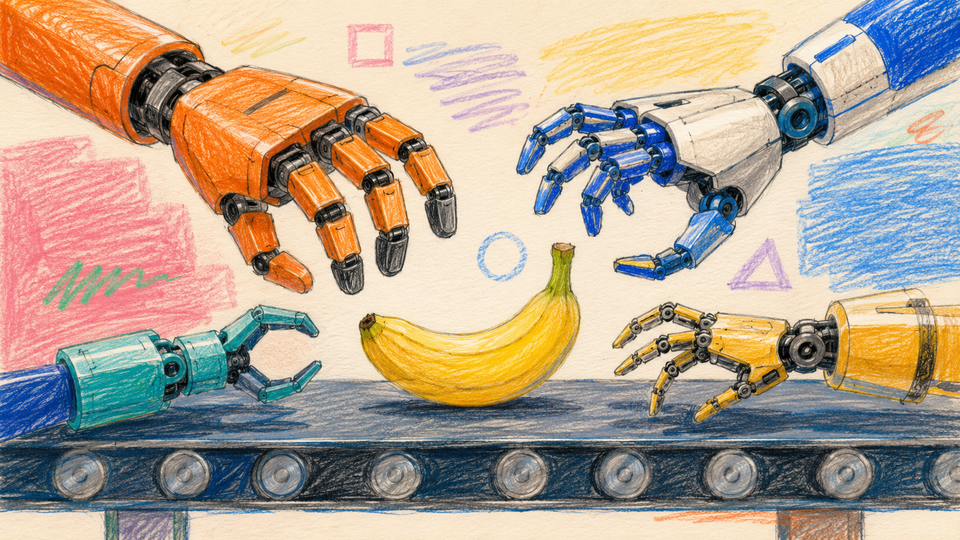
So far, the humanoid robotics narrative has been over-indexed on walking demos, while the commercial bottleneck may be manipulation.
This week, Chinese robotics startup Linkerbot announced the closing of a funding round that valued the company at $3 billion. It also said it was already raising its next round at a $6 billion valuation. According to the company, it currently holds a 80% market share in “high-degree-of-freedom robotic hands” (read: humanoid hands).
The reason hands matter is that it becomes much easier to train AI models for the physical world if robots look and work more like humans. Imagine you run a giant warehouse network and want robots that can pick up items from one shelf and place them on another.
One way to collect training data is to equip all your human workers with cameras and record how they perform those tasks (except in Europe due to GDPR). But that data becomes much more useful if the robots you eventually deploy have human-like hands too. The closer the robot is to the human demonstrator, the easier it is to turn repetitive human actions into robotic movements.
And as we’ve seen across many industries in the past, whether you think automation is good or bad, it seems inevitable.
Linkerbot isn’t the only company paying attention to robotic hands. French startup Genesis AI recently unveiled a demo of its first AI robotic model, GENE-26.5, along with the company’s first set of robotic hands. I encourage you to watch the video demo of Genesis AI’s robot cooking, playing the piano and solving a Rubik’s cube. It’s very impressive.
When it comes to funding:
- Genesis AI raised a $105 million seed round last year.
- Also in France, a good chunk of the team that worked on LeRobot at Hugging Face left to start UMA (and raised less than Genesis AI so far).
There are also a few well-backed American startups exploring the space:
- Physical Intelligence, which is reportedly raising $1 billion at an $11 billion valuation according to my former colleague Natasha Mascarenhas and her new Bloomberg friends.
- Skild AI recently raised $1.4 billion.
And of course, big tech companies are paying attention too. Tesla seems to be increasingly pivoting toward robots. Jeff Bezos is raising billions for Project Prometheus, an “AI manufacturing startup” (so… robots?). And just this week, Meta acquired Assured Robot Intelligence, a company working on AI models for robots.
Based on conversations I’ve had with several robotics researchers, robots may become mainstream much sooner than expected, at least in manufacturing, logistics, and other industrial fields. Maybe we’re at a GPT-3 moment, but for robots.
OpenAI released the GPT-3 model in 2020. At the time, AI researchers and developers were already extremely impressed by the broad capabilities of the model (Hacker News, the popular developer-centric forum, was filled with GPT-3 demos). But it took OpenAI another couple of years to release ChatGPT, the mainstream application that brought LLMs to the masses.
I think we’ll hear much more about AI robotics over the next two years.

The geopolitics of LLMs
EU finance ministers met in Brussels earlier this week. One of the topics on the agenda was Mythos, Anthropic’s AI model that is too useful to hide and too risky to simply ship, as I covered at length in a previous newsletter.
“Banks must be prepared for an environment of heightened uncertainty and rapid technological change,” Greek finance minister and Eurogroup president Kyriakos Pierrakakis said in his closing remarks. “It is for this reason that we decided to kick-off a discussion on AI at today’s meeting. Frontier AI models are evolving rapidly and may soon present challenges of a potentially systemic nature. And we must ensure a framework that supports both stability and competitiveness.”
Translated from Brussels-speak to real talk, Kyriakos Pierrakakis means two things:
- Yes, Anthropic wins this one. European banks will come begging for access to Mythos so they can make sure there are no major security flaws in their systems.
- At the same time, the way Anthropic restricted access to American companies is concerning and should not become the default playbook.
He was even more explicit with reporters after the meeting, as Bloomberg reported. "Indeed there are contacts with Anthropic,” he said. “I don’t think we have the luxury of not trying to establish channels of communication with the U.S. The challenge here is that technologies like AI necessitate international governance frameworks at a moment when multilateralism is challenged,” he added.
What a lovely double negative: “I don’t think we have the luxury of not trying…” Yep, Anthropic forced the EU’s hand and they don’t seem thrilled about it. But what can they do?

AI agents are coming to EVE Online
In lighter news, a quick update on EVE Online, the massively multiplayer online game that has been around for more than 20 years. If you’re not familiar with EVE, it’s a space game where thousands of players interact on the same server. They mine resources, manufacture ships, trade goods, form corporations, wage wars, and occasionally run scams.
This game has always been popular with tech-savvy people because it is often described as a giant economic and political simulation disguised as a video game. Paradoxically, the best part about this digital world is the humans doing very human things.
And now, there’s a tech angle as DeepMind, Google’s AI division, has acquired a stake in the Icelandic company behind EVE Online. The plan is to use the game as a sandbox to evaluate AI models and observe how they behave in a complex but controlled environment.
I personally can’t wait to see AI agents doing weird, space-piratey things in EVE Online.
Have a good day ☀️
Romain